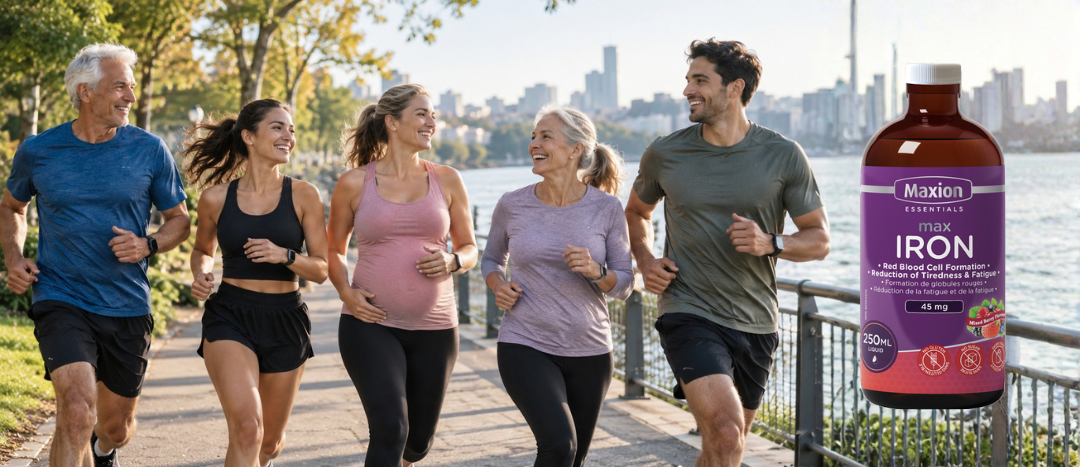
 Feeling tired, running down, or just not like yourself? When iron levels run low, tiredness and fatigue can follow. Maxion Max Iron is a mixed berry liquid that pairs chelated iron bisglycinate with Vitamin C in every teaspoon. It helps your body build healthy red blood cells and keep oxygen moving where it needs to go.
What's in Maxion Max Iron? Two Nutrients, One Smart Pairing
Iron (II) Bisglycinate – 45 mg
Iron is essential for making hemoglobin, the protein in red blood cells that carries oxygen from your lungs to every tissue in your body. When iron runs low, your body struggles to produce enough healthy red blood cells, and tiredness, weakness, and low energy often follow (Abbaspour et al., 2014).
Max Iron uses iron bisglycinate, which is iron bound to two molecules of the amino acid glycine. This chelated structure helps protect the iron as it moves through the digestive tract. Research shows that iron bisglycinate is less affected than conventional iron salts by dietary compounds like phytates that normally interfere with absorption (Layrisse et al., 2000).
A 2023 meta-analysis of 17 randomized controlled trials compared ferrous bisglycinate with other iron supplements. In pregnant women, bisglycinate was associated with higher hemoglobin levels and fewer reported gastrointestinal side effects (Fischer et al., 2023).
Vitamin C as Calcium Ascorbate – 83 mg
Vitamin C is best known for immune support, but it is also one of iron's most important partners. Non-heme iron is the form found naturally in plant foods and is also used in many fortified foods and supplements. Vitamin C helps keep iron in a soluble form in the gut, which supports the absorption of non-heme iron (Lynch & Cook, 1980). In a study of 299 people, adding Vitamin C to meals significantly increased non-heme iron absorption, especially from meals rich in absorption-blocking compounds like phytates and tannins (Hallberg et al., 1986). Health Canada recommends pairing plant-based iron sources with Vitamin C for this reason (Health Canada, n.d.).
Max Iron provides its Vitamin C as calcium ascorbate, a buffered, non-acidic form of Vitamin C.
Why Iron and Vitamin C Belong Together
The amount of iron you take is only part of the story. How well you absorb it matters too. Iron from plant foods is generally absorbed less efficiently than heme iron from animal foods, and its absorption depends on what else you consume at the same time (Hurrell & Egli, 2010).
Iron provides the building block for healthy red blood cells. Vitamin C supports the absorption of non-heme iron. Max Iron puts them together in a single daily serving.
Why Choose a Liquid Iron Formula?
Many people find iron pills hard to swallow, or they skip doses because of an unpleasant aftertaste. Max Iron's liquid format makes daily iron simple:
-
One teaspoon a day, with no large tablets to swallow
-
A pleasant mixed berry flavour
-
Easy to measure and take with food
-
A good option for anyone who has trouble with pills
Approved Uses You Can Trust
Maxion Max Iron is a licensed Canadian Natural Health Product (NPN 80104212). It is authorized to:
-
Help prevent iron deficiency anemia and associated tiredness and fatigue
-
Help form red blood cells and support their proper function
-
Help maintain normal muscle function and immune function
-
Help maintain the body's ability to metabolize nutrients
-
Provide antioxidants for the maintenance of good health
-
Help pregnant women meet Health Canada's recommended iron intake, when taken with a healthy diet
Who Should Consider Maxion Max Iron?
Iron needs vary with age, sex, diet and life stage. Max Iron may be a good fit for:
-
Women with higher iron needs, including during pregnancy
-
People following vegetarian or plant-based diets, since iron from plant foods isn't absorbed as readily as iron from meat, poultry and fish
-
People who have been advised to increase their iron intake
-
People who prefer a liquid over pills or capsules
Iron isn't something everyone needs to supplement, and it can interact with certain medications. Check with your healthcare provider, especially if you are pregnant, nursing or taking other supplements.
Tips for Getting the Most from Your Iron
-
Take one teaspoon (5 mL) daily with food
-
Take it a few hours before or after other medications or natural health products
-
Avoid drinking coffee or tea at the same time as your dose
-
Include iron-rich foods like beans, lentils, leafy greens and lean meats in your diet
-
Stay consistent, since rebuilding iron stores takes time
The Bottom Line
Iron is essential for healthy red blood cell formation and oxygen transport, but getting enough is about more than the number on the label. With 45 mg of chelated iron bisglycinate and 83 mg of Vitamin C in every teaspoon, Maxion Max Iron brings together iron with a nutrient known to support non-heme iron absorption, all in convenient mixed berry liquid.
Support your iron. Support your energy. Keep moving forward with Maxion Max Iron.
References
Abbaspour, N., Hurrell, R., & Kelishadi, R. (2014). Review on iron and its importance for human health. Journal of Research in Medical Sciences, 19(2), 164–174.
Fischer, J. A. J., Cherian, A. M., Bone, J. N., & Karakochuk, C. D. (2023). The effects of oral ferrous bisglycinate supplementation on hemoglobin and ferritin concentrations in adults and children: A systematic review and meta-analysis of randomized controlled trials. Nutrition Reviews, 81(8), 904–920. https://doi.org/10.1093/nutrit/nuac106
Hallberg, L., Brune, M., & Rossander, L. (1986). Effect of ascorbic acid on iron absorption from different types of meals. Human Nutrition: Applied Nutrition, 40(2), 97–113.
Health Canada. (n.d.). Iron. Government of Canada. https://www.canada.ca/en/health-canada/services/nutrients/iron.html
Hurrell, R., & Egli, I. (2010). Iron bioavailability and dietary reference values. The American Journal of Clinical Nutrition, 91(5), 1461S–1467S. https://doi.org/10.3945/ajcn.2010.28674F
Layrisse, M., García-Casal, M. N., Solano, L., Barón, M. A., Arguello, F., Llovera, D., Ramírez, J., Leets, I., & Tropper, E. (2000). Iron bioavailability in humans from breakfasts enriched with iron bis-glycine chelate, phytates and polyphenols. The Journal of Nutrition, 130(9), 2195–2199. https://doi.org/10.1093/jn/130.9.2195
Lynch, S. R., & Cook, J. D. (1980). Interaction of vitamin C and iron. Annals of the New York Academy of Sciences, 355, 32–44. https://doi.org/10.1111/j.1749-6632.1980.tb21325.x